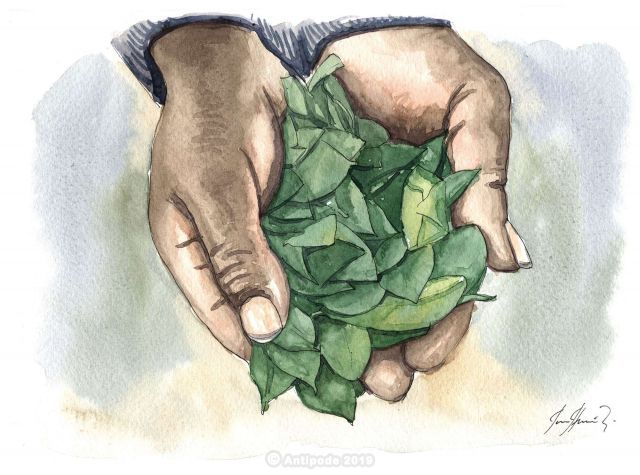

Coca leaf… from Indians to Coke
In Peru, the coca leaf is legal and part of everyday life in the Andes: people chew it, drink it as a tea (mate de coca) and offer it to Mother Earth during rituals. It has nothing to do with cocaine, which is obtained through a chemical process. Revered at times and fought against at others, this little leaf has had an eventful history, from the Incas to Coca-Cola.
A sacred plant of the Andes
The coca leaf has always held a central place in the civilizations that lived in what is now Peru. A sacred plant, under the Incas it was reserved for the elite and for religious ceremonies. It is still at the heart of many rituals today, such as the offering to the Pachamama, Mother Earth: three fine leaves, the "k'intu", are chosen and offered to the protective mountains before a journey or an important task.
During colonization, the Spanish clergy condemned it as the "devil's leaf", as part of their fight against Andean beliefs. But the colonists soon saw its value: handed out to workers in the silver mines, it helped them endure hunger, cold and fatigue.
From the coca leaf to Coca-Cola
At the end of the 19th century, coca fascinated Europe and the United States. American pharmacist John Pemberton drew inspiration from a coca tonic wine, very fashionable in France, to create his own drink. By combining it with the kola nut, he invented Coca-Cola in 1886. Today the recipe no longer contains cocaine, but "decocainized" coca leaves, legally imported, are said to still be used for flavoring.
Coca leaf and cocaine: what is the difference?
The leaf contains less than 1% alkaloids, and chewing it or drinking it as a tea has no effect comparable to the drug. Cocaine, on the other hand, is chemically extracted from large quantities of leaves.
From the 1960s, drug trafficking spread across South America, and many poor farmers turned to growing coca, more profitable than crops whose prices were collapsing. In the 1990s, the fight against drug trafficking intensified. "Alternative development" programs, encouraging other crops such as cacao or coffee, have had mixed results. In Peru, growing and selling the leaf for traditional use is regulated by the state.
How do Peruvians use coca?
In the Andean countryside, farmers chew the leaves throughout the day: this is called "chacchar" or "acullico". A ball of leaves is kept in the cheek with a little "llipta", a paste of plant ash that helps release the active compounds and softens their bitter taste. Coca helps people cope with physical effort at altitude, curbs hunger and aids digestion. Sharing coca leaves is also a gesture of friendship and respect.
For travelers, the easiest way to try it is mate de coca, served in every hotel in the Andes. It helps with acclimatization, alongside the advice in our article Health and trip in Peru. You can also find coca candies and cookies.
Can you bring coca back from Peru?
No. Although legal in Peru, the coca leaf is classified as a narcotic in most countries, even as coca tea bags or candies. Country-by-country rules, customs risks, drug tests and legal alternatives: it is all explained in our article Can you bring coca leaves back from Peru?


