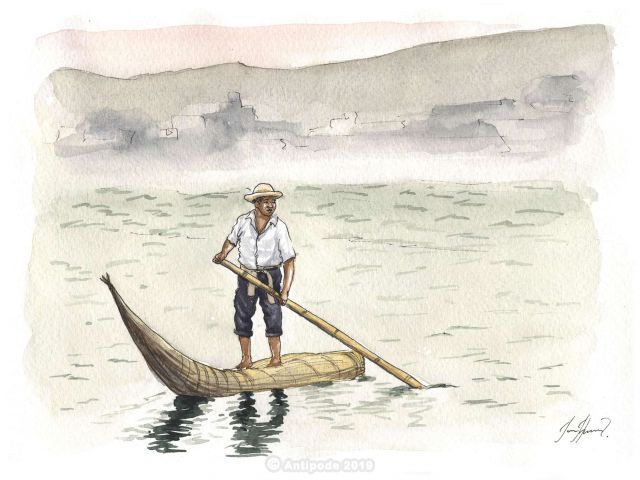

Caballos de totora (little reed horses’)
Totora is a tall reed (Schoenoplectus californicus) that grows in shallow water, both on the shores of Lake Titicaca and in the lagoons of Peru's north coast. Light, waterproof and easy to work, it has been used for centuries to build boats, houses and even entire islands.
Caballitos de totora, the ancestors of surfing
On the north coast, fishermen still use caballitos de totora, the "little reed horses". These narrow craft, made of two bundles of totora tied together and curved up at the front, are ridden astride or kneeling. The fisherman paddles out through the waves to reach the shoals of fish, then rides the swell back to shore. Many see it as one of the oldest forms of wave riding in the world.
The technique goes back to pre-Columbian cultures: caballitos have been used for nearly 3,000 years and can be recognized on Moche ceramics. The Chimú, builders of Chan Chan, used them too.
Where to see the caballitos
The best-known village is Huanchaco, a few kilometers from Trujillo. In the morning, fishermen head out to sea from the beach, and in the afternoon the caballitos dry upright on the sand, lined up facing the ocean. You can also see them in Pimentel, near Chiclayo. Some fishermen offer visitors a short ride.
On Lake Titicaca, islands made of reeds
At nearly 3,800 m above sea level, the Uros live on floating islands made of blocks of totora roots covered with layers of reeds. New reeds must be added constantly, as the base rots in the water, and an island has to be completely rebuilt about every thirty years. Houses, boats with puma-shaped prows and some of the crafts are also made of totora. The soft white base of the reed, called chullo, is even eaten.
Boats that crossed the oceans
The skills of the Titicaca builders have traveled far. In 1970, the Norwegian explorer Thor Heyerdahl called on Aymara craftsmen from the lake to build Ra II, a papyrus boat on which he crossed the Atlantic. Craftsmen from Suriqui, an island on the Bolivian side of the lake, later helped him build the Tigris in Iraq, in 1977.


